Kya Clark
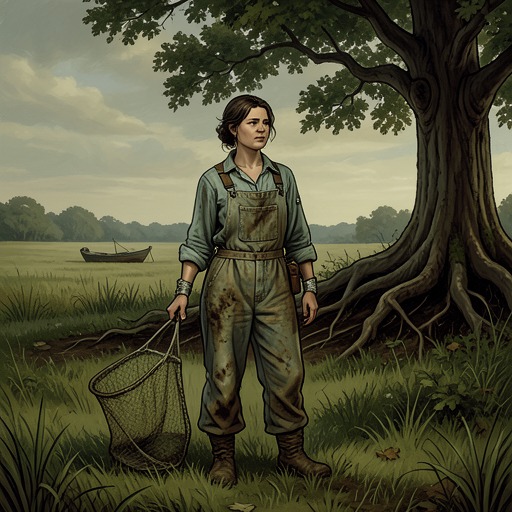
Where the Crawdads SingKya Clark grows up in the marsh after her mother leaves, and the landscape becomes more than shelter: it takes the place of family, school, and community. She learns its living patterns with extraordinary intimacy, teaches herself to read with help from Tate Walker, and turns years of observation into a published natural-history book. Her independence is hard-won, but it does not erase the costs of abandonment or protect her from the suspicion directed at the so-called Marsh Girl.
Identity and Early Loss
In 1952, Kya is six years old and scrubbing grits from a pot when a screen door slaps. She knows at once that something is wrong: her mother, Ma, never lets the door slam. From the porch, Kya sees Ma walking away in her only pair of going-out shoes, carrying a blue train case. Ma has often walked down the lane and returned with food, but the case and the high heels distinguish this departure from those ordinary errands. Kya runs toward the place where the path opens onto the road, hoping for the familiar wave. She sees only the blue case disappearing through the woods, then goes back to wait.
The loss first registers in domestic absences. Kya wakes expecting the sounds and smells of Ma’s cooking: scrambled eggs from her hens, tomatoes, and cornbread fritters crackling in hot grease. The kitchen is now cold and silent. As months pass, she goes deeper into the marsh, frightened at times by unfamiliar night sounds and nearby lightning, but repeatedly steadied by the land. Her grief does not vanish; it sinks out of immediate reach. She lays a hand on the wet earth, and the marsh becomes her mother—a relationship that gives her a source of care, even as it marks the absence that made such care necessary.
Survival and Self-Reliance
When Kya believes Pa has gone for good, she struggles to mourn him as she mourned Ma. What overwhelms her is the prospect of being entirely alone and discovered by authorities who might take her away. She decides she must act as if Pa is still around, even when dealing with Jumpin’. His absence also ends the Monday money. Kya stretches a few dollars for weeks, eating grits, boiled mussels, and occasional eggs from the hens; by then, her remaining supplies amount to matches, a small piece of soap, and a handful of grits. Even cooking becomes a matter of survival because without matches she cannot boil the food she prepares for herself, the gulls, and the chickens.
The marsh offers both livelihood and knowledge, but it does not make her materially secure. At fourteen, Kya can read tides, find her way by stars, and recognize the feathers of an eagle, yet cannot read a note written in simple script. Her abilities are extensive but uneven, shaped by close attention to the natural world rather than formal schooling. That contrast captures her circumstances: she is not without knowledge, but has been denied the ordinary means by which the surrounding society recognizes and exchanges it.
Learning, Connection, and Retreat
Tate Walker re-enters Kya’s life through a quiet exchange of feathers. Years earlier, he had shown her the way home through the marsh; she had watched him from a distance without daring to approach. At fourteen, she leaves a graceful tundra-swan tail feather at a stump and finds Tate there, waiting beside it. Their wordless custom is disrupted by their meeting, but it also becomes a way for contact to begin without requiring Kya to abandon the caution that has protected her.
Tate recognizes the gap between Kya’s knowledge of the natural world and the skills she has not been taught. He helps her read and brings her books; Kya then ranges through the written world, reading the directions on a grits bag, Tate’s notes, and fairy tales she had pretended to read for years. One night she opens the family Bible and finds her own entry: Miss Catherine Danielle Clark, born October 10, 1945. Reading upward, she discovers her siblings’ full names, including Jeremy Andrew Clark, and lingers over Amanda Margaret Clark’s name. Literacy gives her access not only to practical text but also to a written record of the family from which she has been separated.
Tate also defends her against the town’s gossip. When his father warns him about being involved with the Marsh Girl, Tate objects to the contradiction between professed disbelief and suspicion, and explains that he is teaching Kya to read because people in town have been cruel to her and she could not attend school. His defense does not undo that exclusion. After Tate abandons her, Kya withdraws from people, makes supplies last, and eventually stops visiting Jumpin’ except when necessary. The return of a Cooper’s hawk to her steps prompts her to take the boat into the channels again, searching for nests, feathers, and shells. By the end of August, her routine of boating, collecting, and painting has restored its shape, while her social world remains narrowed by hurt.
Natural History and a Public Identity
Kya’s collections grow into an ordered body of work, arranged by categories such as genus and species, bone wear, feather size in millimeters, and subtle differences in color. Scientific classification and painting are intertwined: her shack fills with work that is at once careful observation and an artistic record of life. The collections give structure to a world in which human attachment has proved unreliable, but they also become the foundation of a public identity beyond the label imposed on her by Barkley Cove.
More than a year after Chase Andrews and Pearl announce their engagement, Kya—then in her twenty-second year—begins checking the mailbox every day. The waiting ends with a bulky manila envelope containing an advance copy of The Sea Shells of the Eastern Seaboard, published under her full name, Catherine Danielle Clark. Tate’s initial contact with the publisher had led to her submission of more drawings and a contract. Because the text and paintings for the shell specimens had been completed years earlier, editor Robert Foster told her that the book would appear quickly and that a second volume on birds would follow. The publisher also sent a five-thousand-dollar advance. Alone on the beach, Kya examines the finished pages: her words, colors, and brushstrokes have been reproduced in a book, including drawings of the creatures living inside shells and accounts of how they eat, move, and mate. The achievement makes her knowledge legible to readers far beyond the marsh, though the moment of receiving it is still one she has no one nearby to share.
Land, Arrest, and Narrative Significance
Kya’s sense of belonging to the marsh is also tied to the question of who owns it. Uncertain whether her family owns the land or has simply occupied it, she wraps the old Bible in cloth and takes it to the Barkley Cove courthouse. A county clerk consults records, maps, and aerial photographs while Kya points out her lagoon and sketches the boundaries she understands as hers. He finds a deed showing that the land was surveyed and bought in 1897 by Napier Clark. Kya recognizes the name as her grandfather’s from the Bible’s records of births and deaths, connecting her claim to a documented family history rather than to occupation alone.
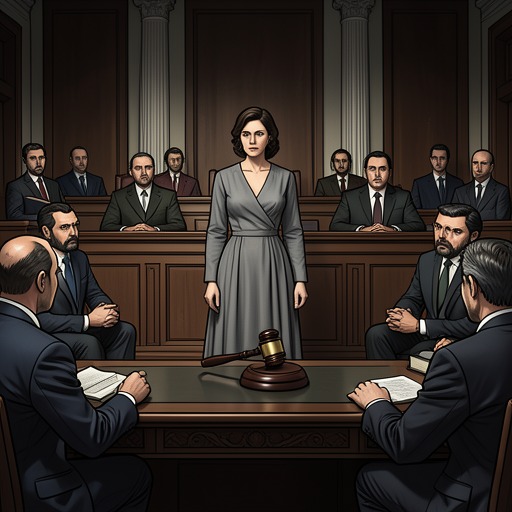
Her eventual arrest turns that solitary life into a direct confrontation with the town’s authority. During a storm, pursued by faster boats, Kya considers jumping into the sea and using the current to reach shore. Instead, the boats close around her; one cuts in front of her and her boat strikes its side. The sheriff grabs the gunwale, two men climb aboard, and a deputy tells Miss Catherine Clark that she is under arrest for the murder of Chase Andrews. Kya does not hear the rest of the warning. The scene brings the gulf between her hard-earned independence and the power of the outside world into sharp focus: the marsh has sustained her, but it cannot keep the law from reaching her.
Kya’s story joins two forms of reading. She studies the marsh through patient attention to species, tides, and traces of life, and later learns to read the human records that identify her family and land. Her scientific work gives that knowledge a durable form, while her isolation leaves her vulnerable to rumor and suspicion. The girl who once waited for Ma’s return becomes an author under her own name, but belonging remains unsettled: it is something she finds in the marsh, documents through the family deed, and must defend against the judgments of Barkley Cove.